
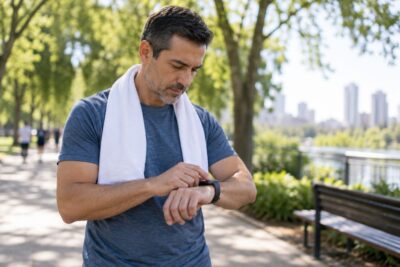
 Wearable technology is increasingly becoming part of the way researchers measure physical activity, rather than serving only as a personal step counter. The World Health Organization has examined device-based measurement as part of efforts to improve physical-activity surveillance. Researchers working in this area argue that accelerometers and similar tools could provide more standardized information than relying entirely on people to remember and report how much they moved.
That development reflects how much fitness trackers have changed. A wristband or smartwatch may now estimate steps, active minutes, sedentary periods, heart rate, sleep duration and recovery. Some devices also calculate cardiovascular fitness, heart-rate variability and estimated energy expenditure. The result is a stream of information that can make everyday activity more visible.
What Are Wearables Actually Measuring?
Most trackers begin with sensors. Accelerometers detect movement, while optical sensors can estimate heart rate by measuring changes in blood flow beneath the skin. Devices combine those signals with information such as age, body size, GPS data and proprietary algorithms to calculate other metrics.
That distinction matters. A tracker directly senses certain signals, then estimates many of the numbers shown on the screen. A “calories burned” figure, recovery score or sleep stage is usually an algorithmic interpretation rather than a direct laboratory measurement. A cardiovascular review published through the National Institutes of Health found substantial differences in accuracy depending on the metric and device being tested.
Where Fitness Trackers Can Be Genuinely Useful
Wearables are particularly useful for spotting patterns. Someone who normally averages 8,000 steps but suddenly spends several weeks closer to 4,000 can see that change clearly. The same principle applies to resting heart rate, exercise frequency and sleep duration.
Device-based measurement may also help population researchers. Traditional questionnaires are inexpensive and practical, but people can overestimate activity or forget sedentary time. Research comparing questionnaires with accelerometers has repeatedly found differences between reported and measured behavior.
Where the Numbers Become Less Certain
Some wearable measurements remain much harder to interpret. Estimated calorie expenditure is one example. Reviews summarized by the National Institutes of Health found that commercial devices can substantially understate or overstate energy expenditure. That makes calorie-burn totals a poor reason to precisely increase or decrease food intake.
Sleep data has similar limitations. Watches can be useful for estimating when someone slept and identifying broad patterns, but sleep stages are more difficult. A 2024 systematic review in JMIR mHealth and uHealth comparing Fitbit, Garmin and WHOOP devices with laboratory polysomnography found differences in the accuracy of individual sleep stages.
Use Trends, Not Single Numbers
The most useful way to read wearable data is often to compare yourself with your own baseline. A steadily rising resting heart rate, falling activity level or repeated short nights may be more informative than one unusually high or low reading.
It also helps to separate wellness information from medical assessment. Consumer trackers can encourage movement and reveal patterns worth discussing with a healthcare professional. They cannot automatically explain why a measurement changed or diagnose a condition.
Fitness trackers are therefore becoming more sophisticated health tools, but their greatest value may remain surprisingly simple. They can help people notice patterns that are difficult to see from memory alone. Used that way, wearable data becomes a guide for better questions rather than a final medical answer.